
The mechanism, plainly
A generation model receives a description and produces something consistent with it. It does not receive, and does not retain, the thing it produced last time. Every call is a fresh interpretation of a sentence, and interpretation has variance.
Across one shot the variance is invisible. Across an episode it is noticeable. Across forty episodes it is the show falling apart, and no amount of adding adjectives to the sentence closes the gap, because adding adjectives is still describing rather than referencing.
- The character exists as words
- Each generation re-interprets them
- Variance compounds across episodes
- A model change restarts interpretation from zero
- There is nothing to compare a result against
- The character exists as approved references and state
- Every shot inherits the same references
- Results are evaluated against them
- A model change does not alter who she is
- Drift becomes a detectable mismatch
The half nobody tries to fix
Visual drift gets all the attention because it is visible. The drift that ruins serialized stories is narrative, and it is invisible to anything that compares pixels.
A character who knows something they have not been told. A prop in two places at once. An injury that heals between episodes. A relationship that resets after a betrayal. Every one of these can occur in a technically flawless shot, and an audience following the story catches all of them.
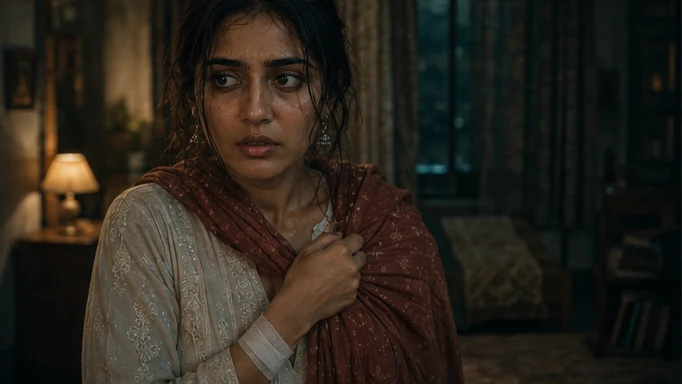
Episode two. Anaya names the letter's author. The shot is well composed, well performed, and the identity match is exact.
- Visual check
- Passes. It is her, in the right costume, in the right room.
- Story state
- She has not read the letter as of this scene.
- Verdict
- Contradiction. The shot cannot exist.
The only reason this is catchable is that episode two recorded what she did not yet know. Nothing about the image gives it away, which is why knowledge state belongs in canon rather than in a writer's memory.
What this does not solve
Frequently asked questions
Will better prompting fix character drift?
It reduces the variance a little and it does not change the mechanism. As long as identity is reconstructed from a description on every call, the reconstruction has variance. The fix is to stop reconstructing.
Do reference images solve it?
They are most of the answer for visual identity, provided the reference set covers the framings the show actually uses. A single flattering portrait holds in one angle and collapses in the close-ups a vertical drama is mostly made of. They do nothing for narrative drift.
What is narrative drift?
A character acting inconsistently with what is true in the story: knowing something untold, holding something they gave away, healed from something unresolved, or trusting someone who just betrayed them.
How do you catch narrative drift?
By recording story state - knowledge, possessions, physical state, relationships - and checking generated work against it. A contradiction is then a specific flag with a reference it failed, rather than something a reviewer may or may not notice.
Does this get easier as models improve?
Visual drift probably does. Narrative drift does not, because it is not a model capability problem. A model with no access to your story state cannot avoid contradicting it, however good it gets.