02 / Seedance
Where Seedance fits in your story
Seedance is a candidate for scenes whose camera rhythm, action or sound cue benefits from explicit references. For a branded story, the AI Director can separate the approved product image from the movement reference, so the model receives a clear role for each input instead of an ambiguous bundle.
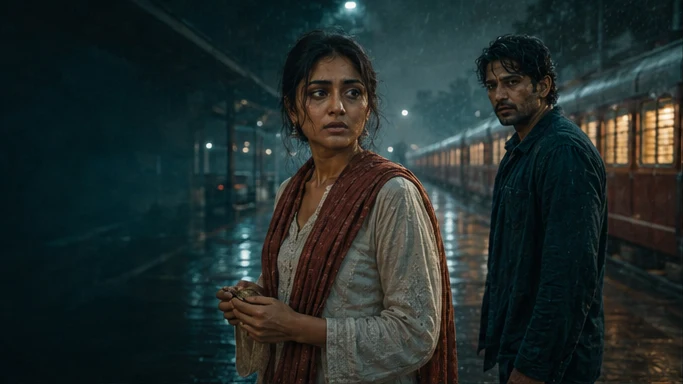
Move with Anaya as she crosses the platform, then let the camera settle when she notices Kabir.
- Reference
- Use a cleared movement reference for the camera path.
- Pacing
- Travel during the approach. Hold on recognition.
- Sound
- Keep the sound cue aligned with the change in pace.
03 / Seedance
Plan the Seedance handoff
The AI Director prepares the video request from the scene plan, using AI Skills to specify the framing, performance or sound intention. You can review creative preparation or use Auto mode within your chosen scope. The model receives a bounded job, with the references and constraints that matter to that asset.
For an independent creator, this connects a creative decision to the next production step. For a publisher, it keeps recurring assets attached to the episode plan. Brand buyers can carry approved product references into the shot; production houses can retain the treatment and handoff requirements across the sequence.
04 / Seedance
The arithmetic nobody does
Per-generation pricing invites a comparison that does not mean anything, because a generation is not the unit of value. An accepted shot is. Everything before acceptance is cost.
So the cost of a shot is the attempt price multiplied by the number of attempts, plus the reviewer time each attempt consumed, plus the repair attempts, plus whatever a collateral change forced elsewhere. A provider that is cheap per attempt and needs many attempts can easily be the expensive choice, and the only way to know is to measure acceptance.
05 / Seedance
The version treadmill
Provider documentation
Capabilities checked against official sources. Story applications are Tosheo’s editorial examples, not comparative benchmarks.
ByteDance Seed: Seedance capabilitiesQuestions before production
Is a cheaper model actually cheaper?
Only if its accepted-shots-per-attempt holds up. A low attempt price with a low acceptance rate costs more in both money and reviewer time. That is why the metric we track is variable cost per accepted publish-ready minute rather than a per-generation price.
Who pays when a generation fails?
We do. Provider failures and retries are accounted for as a Tosheo cost, not a customer cost. The party choosing the router should carry the cost of choosing badly, and that is a deliberate incentive rather than a courtesy.
Do you offer unlimited generation?
No, and we will not. Unlimited generation is a pricing model that only works by discouraging use or by degrading quality. Generation is metered or budget-authorized against a ceiling a named person approved.
Why not write a page for each model version?
Because those pages expire, they cannibalise each other for near-identical search terms, and they pull the site toward competing on model access - which our brief explicitly rules out. One page per durable idea outlives five per release cycle.
What will you publish about cost?
Our own numbers from our own demonstration production: cost per accepted minute, attempts per accepted shot, repair examples and language-track results. Publishing that transparently is step two of our acquisition sequence, and no competitor can copy it because it has to be measured rather than asserted.